
Cast acrylic is polymerized in a mold, cell by cell. Extruded acrylic is melted and pushed through a die as a continuous sheet. For furniture the difference decides everything: cast material machines and polishes cleanly at furniture thickness, while extruded sheet is thinner, cheaper and prone to crazing at cut edges.
What is the actual difference?
It is molecular weight and internal stress. Casting builds long polymer chains slowly in a mold, so the finished block is more uniform and holds together better when a cutter goes through it. Extrusion forces molten material through a die at speed, which aligns the chains and freezes stress into the sheet.
The manufacturer’s own comparison says the same thing in process terms: cell cast sheet is poured as liquid monomer between glass and cured in an autoclave, while extrusion uses grades with a lower molecular weight. Cast material therefore has less tendency to melt or chip during machining, handles long-term mechanical loads better, and comes in far greater thicknesses, over one inch. Extruded sheet is cheaper, holds tighter thickness tolerance and cements faster.
Locked-in stress is invisible until you cut, drill or glue. Then it shows as crazing, the fine white cracks that spread from a hole or an edge. Extruded material also softens at a lower temperature, which is useful if you want to thermoform it and a problem if you want to machine it.
| Property | Cast acrylic | Extruded acrylic |
|---|---|---|
| Made by | Polymerizing in a mold or cell | Melting and pushing through a die |
| Thickness available | Thin sheet up to solid blocks | Sheet, generally thinner |
| Machining | Cuts and carves cleanly, chips break away | Gums and melts more readily |
| Crazing risk at cuts | Lower | Higher, stress relieved cuts are essential |
| Thickness consistency | Varies slightly across the sheet | Very consistent |
| Cost | Higher | Lower |
| Best for | Furniture, sculpture, thick carved parts | Signage, glazing, thermoformed shapes |
Process, molecular weight, thickness range, machining behavior and cost in the table above follow Polyvantis, “What is the difference between cast and extruded acrylic sheet?” (manufacturer knowledge base, read 18 September 2026). The crazing and joint notes below are what we see on our own shop floor.

Where does extruded sheet fail in furniture?
Three places, and they are all joints.
- Bonded seams. Solvent plus locked-in stress equals crazing along the glue line, often weeks after assembly.
- Fixing holes. A drilled hole concentrates stress. In extruded sheet the cracks start there and radiate.
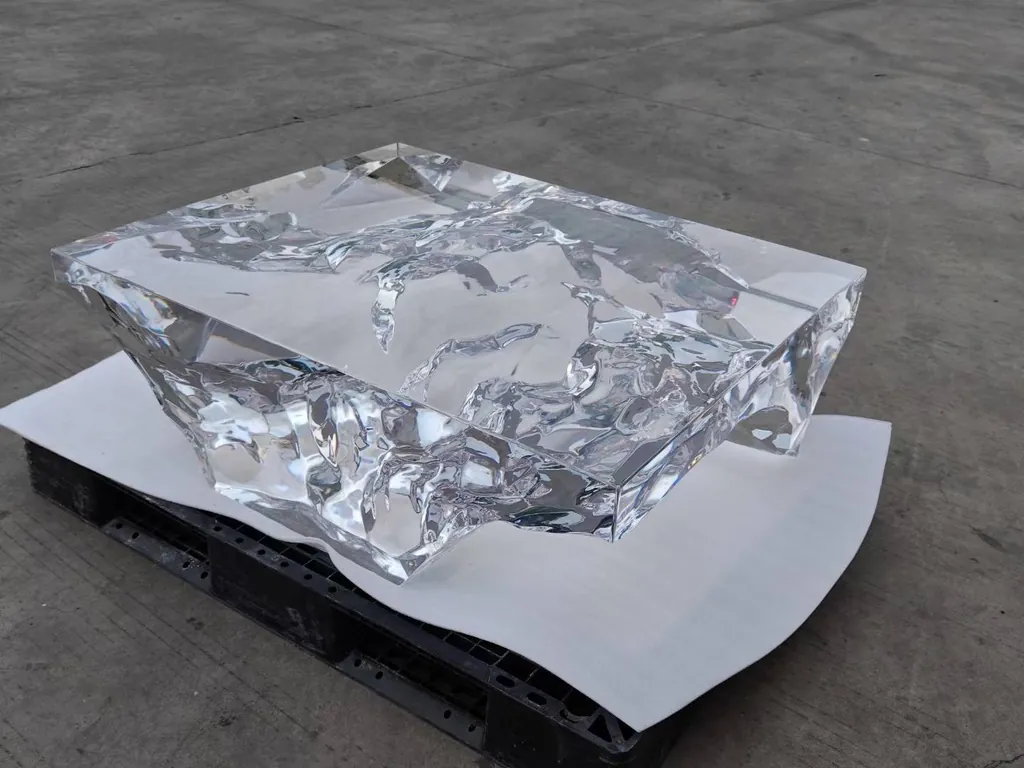
- Carved surfaces. A deep texture needs material to cut into. Sheet that is 10mm thick cannot carry a 6mm facet and still be a table.
None of that makes extruded material bad. It is the right choice for a light box or a shop sign. It is the wrong choice for a dining table that has to last a decade.
How do you tell them apart on arrival?
- Check the masking film. Producers usually print the grade on it, and cast material is labeled as cast or as cell-cast.
- Drill a test hole in an offcut. Extruded material gums onto the bit sooner and shows a milky ring.
- Look at the edge of a thick section against the light. Cast stock is generally more even in color through the depth.
- Ask what thickness range the supplier stocks. A supplier who only holds sheet up to 20mm is not selling you a carved table.
Everything we build starts from cast stock, and we anneal after machining and bonding to take the remaining stress out. You can see the blocks, the routers and the annealing step in the cast acrylic manufacturing process.
Does cast acrylic cost more than it is worth?
For a flat panel, often yes. For anything carved, bonded or thicker than about 20mm, the extra material cost is smaller than the cost of the failures you avoid. A crazed joint is not repairable; it is a replacement.
Related reading: whether cast acrylic furniture turns yellow. Or see the pieces this material becomes in our console and side table range.
Not sure which your drawing needs?
Send it over. We will tell you the thickness the piece actually needs and what it should be cut from.